
The traditional crown process has a middle chapter nobody enjoys. You come in, the tooth is prepared, impressions are taken, and then a temporary crown is cemented into place while your permanent one is manufactured at an outside laboratory — often several states away. Two or three weeks later, you come back, the temporary comes off, and the real crown goes on. Assuming it fits.
At Family Dentistry of Forest Hill, we removed that middle chapter. Dr. Daniel M. Casel, DMD, and Dr. Armando Ponte, HBSc, DDS, work alongside an in-house dental laboratory, which means the crown you need can be designed, fabricated, and fitted here rather than shipped out and waited on. For most patients, that collapses a multi-week process into a single appointment.
What Actually Goes Wrong During the Waiting Period
The temporary crown is the weak point, and patients discover this quickly. Temporaries are made from softer material and secured with cement designed to release easily, because it has to come off again. The consequences are predictable.
- Temporaries Come Loose: A sticky food, a hard bite, or sometimes nothing identifiable at all, and the temporary is off. That means an unplanned trip back to the office.
- Sensitivity Is Common: A prepared tooth under a temporary crown is more exposed than it will be once the permanent restoration is in place. Cold sensitivity during those weeks is frequent.
- The Fit Is Approximate: Temporaries are not made to the precision of a final crown. Food can work its way underneath, and the bite often feels slightly off.
- Shade Matching Happens Remotely: When a lab three time zones away matches your tooth color from photographs and a written prescription, the result is sometimes close rather than correct.
- Adjustments Require Another Visit: If the permanent crown arrives and does not seat properly or the bite is high, the crown goes back to the lab and you go back on the calendar.
None of this is a failure of outside laboratories, many of which do excellent work. It is a structural problem with distance and time.
How the Same-Day Process Works
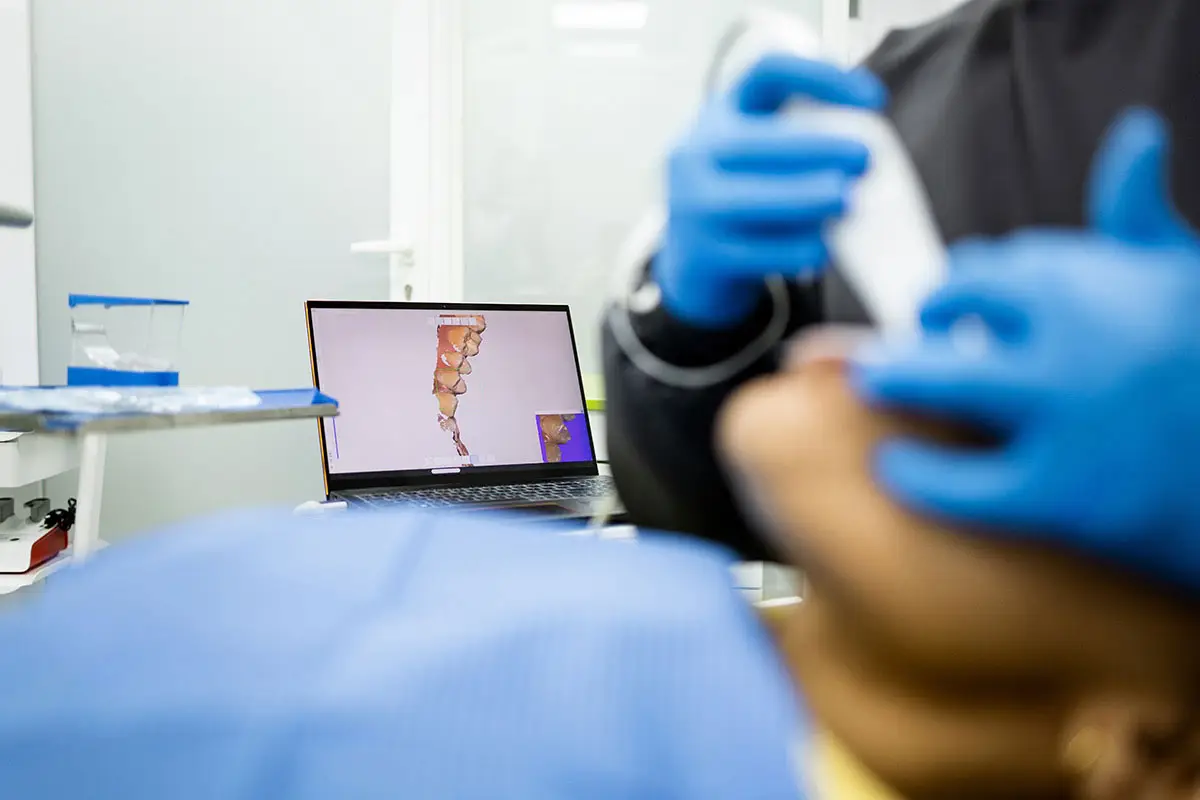
With fabrication happening on site, the sequence changes substantially. The tooth is examined and prepared the same way it always was. From there, digital scanning replaces the putty impression trays most patients remember without affection. The scan produces a precise three-dimensional model of the prepared tooth and the surrounding bite.
That model goes to our lab, where the crown is designed and milled while you remain in the office. Because the dentist and the lab are in the same building, questions get answered in person rather than by voicemail — shade, contour, how the crown should interact with the tooth beside it. When it is ready, it is tried in, adjusted if needed, and cemented permanently.
You leave with a finished tooth. No temporary, no second appointment, no three-week holding pattern.
Where This Matters Most
Same-day fabrication is not a convenience feature alone. In certain situations it meaningfully changes the clinical outcome.
- Front Teeth: Shade and translucency matter enormously on a visible tooth. Being able to compare the crown against your natural teeth in person, under real lighting, and adjust accordingly produces a better aesthetic result than remote matching.
- Cracked or Broken Teeth: A compromised tooth is vulnerable while it waits. Sealing it under a permanent restoration immediately reduces the risk that it fractures further before the crown arrives.
- Patients With Limited Availability: Shift workers, caregivers, and anyone who cannot easily take two mornings off benefit from consolidating treatment into one visit.
- Clear Aligner Treatment: An in-house lab also means aligners are produced here, which shortens the timeline between scanning and starting treatment and simplifies any mid-course adjustment.
- Emergency Situations: When a tooth breaks unexpectedly, the ability to restore it definitively that day rather than stabilize and schedule is a substantial difference.
What a Crown Is Actually For
It is worth stepping back, because patients sometimes agree to a crown without a clear sense of why a filling will not do. A crown covers the entire visible portion of a tooth rather than filling a void within it. That full coverage is what holds a compromised tooth together under chewing force.
Crowns are typically recommended after root canal therapy, when a tooth has cracked, when decay has destroyed too much structure for a filling to be supported, when an old large filling is failing, or to restore a dental implant. The common thread is structural: the tooth can no longer be relied upon to hold itself together.
Choosing to wait is not a neutral decision. A tooth that needs a crown is a tooth that is likely to fracture, and a fracture that extends below the gumline frequently cannot be saved at all. That is the scenario that turns a crown into an extraction and an implant.
Frequently Asked Questions
- Is a same-day crown as strong as a traditional one? Yes. Modern milled ceramic crowns are strong, durable, and designed for long-term function. The difference is where and how quickly they are made, not the quality of the result.
- How long does the appointment take? Longer than a cleaning and considerably shorter than two separate visits. Our team will give you a realistic time estimate when you schedule so you can plan your day.
- Will it match my other teeth? Matching in person, with your natural teeth in front of us, is one of the real advantages of an on-site lab. Shade is selected and verified before the crown is cemented.
- Does the process cost more? Eliminating the temporary crown and the second appointment removes steps rather than adding them. We will provide a clear estimate and review your insurance benefits and financing options before treatment begins.
- Are same-day crowns right for every tooth? Most, but not all. Certain cases — particularly complex implant restorations or extensive full-mouth work — may call for a different approach, and we will tell you honestly if yours is one of them.
Fewer Visits, Finished Work
The practical case for an in-house lab is simple: fewer appointments, no temporary to manage, better shade matching, and immediate adjustments when they are needed. The clinical case is that a tooth protected today is in better shape than a tooth protected in three weeks.
If you have been putting off a crown because the process sounded like more disruption than you could fit into your schedule, it is worth finding out how much shorter it has become. Our team speaks Spanish, we are open on Saturdays, and we welcome walk-ins — because getting care should not require rearranging your life around it.
Schedule Your Appointment at Family Dentistry of Forest Hill
Whether you have a tooth that needs attention now or an old restoration you suspect is failing, an exam will tell you where you stand and what your options look like.
Family Dentistry of Forest Hill is located at 1870 Forest Hill Boulevard, Suite 103, West Palm Beach, FL 33406. Saturday appointments are available and walk-ins are welcome.